
What is Glaucoma?
Glaucoma is a group of eye diseases that damage the optic nerve.
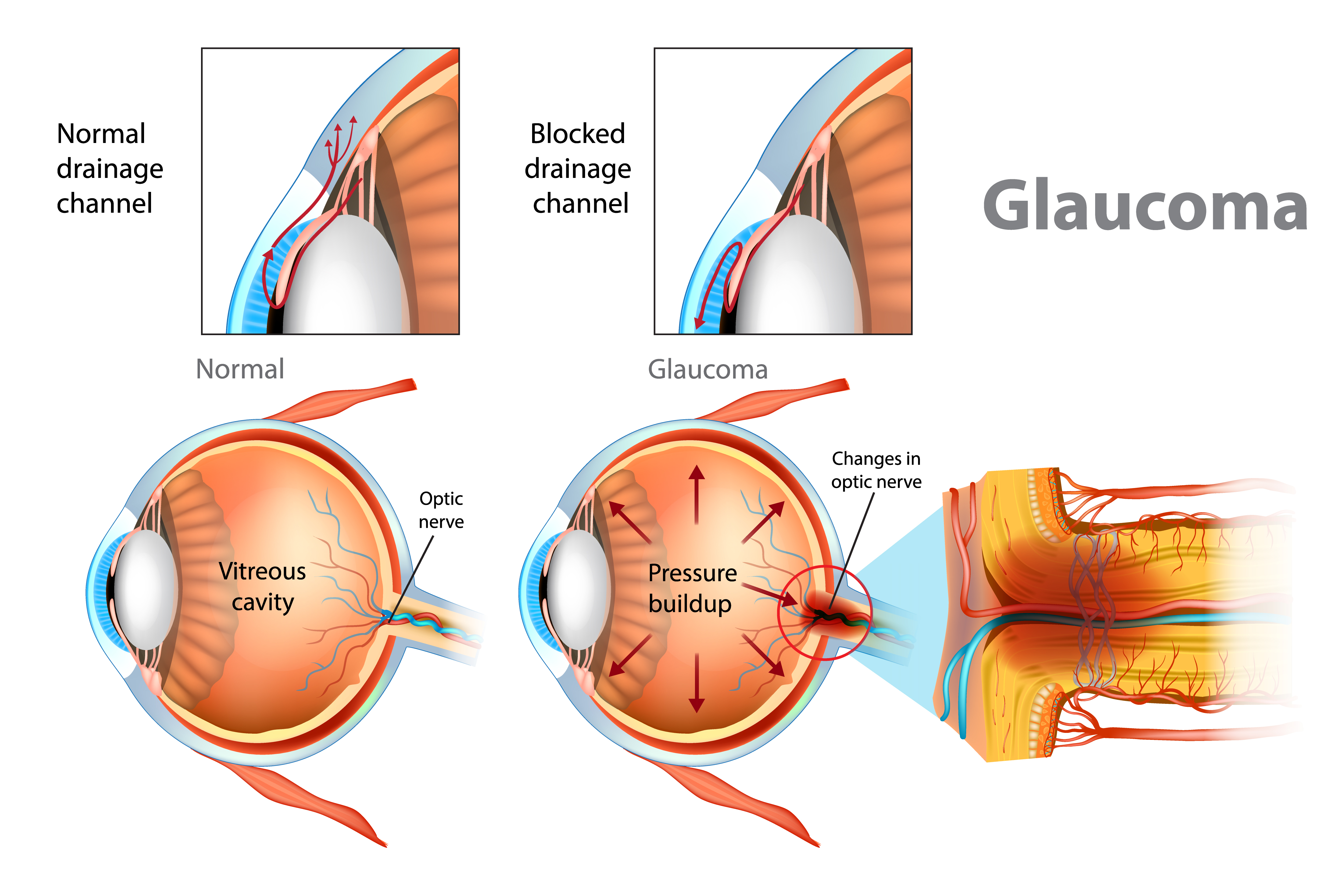
The optic nerve is the part of your eye that carries visual information from the eye to your brain. Your brain then turns the information into images.
Though there are many risk factors for glaucoma including genetics (family members with glaucoma), nearsighted vision, trauma, and chronic steroid use, the one we understand the best is eye pressure. With glaucoma, fluid within the eye (aqueous) builds up in your eye and increases pressure. This increased pressure can damage the optic nerve over time. Without treatment, optic nerve damage can cause permanent vision loss and eventual blindness.
Types of Glaucoma
Open-Angle Glaucoma
Open-angle glaucoma (most common): fluid builds up in the eye due to changes within the aqueous outflow system, leading to elevated eye pressure.
Angle-Closure Glaucoma
Angle-closure glaucoma: this occurs when the aqueous outflow system is physically closed or blocked by structures within the eye. Aqueous fluid cannot drain and this leads to a sudden increase in eye pressure and is a medical emergency.
Congenital Glaucoma
Congenital glaucoma: Childhood glaucoma resulting from abnormal development of the aqueous outflow system is often categorized based on the age of onset. Primary Congenital Glaucoma develops from birth to 3 years of age and Juvenile open-angle glaucoma develops after age 3.
Secondary Glaucoma
Secondary glaucoma: this develops as a complication of another eye surgery, injury, medications, or other ocular diseases.
Glaucoma Risk Factors
Glaucoma is one of the leading causes of blindness. It is estimated that over 3 million Americans have glaucoma but only half are aware of the condition. Although glaucoma can occur at any age, the risk of developing glaucoma increases dramatically after age 60. Other risk factors for glaucoma include:
- Family history of glaucoma
- Presence of diabetes, heart disease or high blood pressure
- Chronic steroid use
- Trauma to the eye
- Certain eye conditions (thin corneas, retinal detachment, etc.)
- Naturally high intraocular pressure
- Aged 40+ years old
- High Myopia (nearsightedness)
- Race (African Americans, Hispanics, Asians, Native Alaskans and Japanese are at higher risk)
Although vision loss from glaucoma is permanent, it can be prevented with early detection and treatment. Our eye care providers offer the most up to date treatment options for glaucoma including medications, laser therapy, and surgery. Regular eye exams are especially important for people over age 60 or those in other high-risk groups.
Contact us today to schedule an eye exam with us to find out if glaucoma is silently stealing your vision.
Glaucoma Symptoms
Glaucoma is often called the silent thief of sight because there are no obvious symptoms with the most common type of the disorder: open-angle glaucoma. Most people do not detect a change in their vision until there has actually been a significant loss of vision. Unfortunately, vision loss from glaucoma is permanent.
Symptoms of Later Stage Open-Angle Glaucoma
- Mild headache
- Tunnel vision
- Blind spots
- Night vision difficulties and difficulty with transitions from light to dark
Symptoms of Angle-Closure Glaucoma
With angle-closure glaucoma, there will be a sudden increase in eye pressure. This is a medical emergency because it can destroy vision very quickly. Symptoms may include:
- Blurred vision
- Severe eye pain
- Nausea
- Halos around lights
- Severe headache
Glaucoma Detection
Although there is no medical cure for glaucoma, with early detection and treatment, glaucoma can almost always be controlled and vision preserved. In most cases, glaucoma can be detected during routine eye exams. Special instruments are used to check the fluid pressures in the eye and a magnifying lens is used to examine the optic nerve and drainage channels for proper fluid outflow.
Even if you are not experiencing any vision changes, it is very important to have regular eye exams so your doctor can identify these types of silent eye conditions. Stay proactive with your eye health: schedule an eye exam with us today. Our eye care providers at the Idaho Eye Center and Laser Center will work with you to preserve your precious vision.
Glaucoma Treatments
Although there is no medical cure for glaucoma, with early detection the condition can be treated and managed to help slow and prevent vision loss.
Our eye care providers, including our fellowship trained glaucoma specialist, offer the most up to date treatment options. These include:
- Medicated eye drops
- Sustained release medication implants
- Selective Laser Trabeculoplasty (SLT)
- Micropulse and G-probe Cycophotocoagulation
- Laser peripheral iridotomy
- Filtration implants (XEN® Gel Stent, tube shunts)
- Trabeculectomy (filtration surgery)
- Minimally Invasive Glaucoma Surgery (MIGS)
- Microbypass stents (iStent®, Hydrus®)
- Canaloplasty
- Goniotomy
How We Manage Glaucoma
Detailed Glaucoma Treatments
There are a variety of medicated eye drops that can be prescribed to decrease eye pressure. Your doctor may prescribe drops that increase the outflow of the fluid of the eye (aqueous), reduce the production of fluid, or drops that achieve both.
Newer technology allows our surgeons to implant slow-release glaucoma medications into the eye. This treatment prevents the burden of daily eye drops and in some cases the medication effect can last for over a year.
A low risk, in-office procedure, where laser energy is used to help open channels in the aqueous drainage system of the eye. This can be used as first-line treatment for glaucoma and may prevent the need for medication.
Laser energy is applied to the ciliary body (where aqueous fluid is produced) to slow down fluid production and reduce eye pressure.
A laser used in specific types of glaucoma to create an alternate drainage pathway for patients with narrow, crowded, or closed aqueous outflow systems. This can be used as a preventative measure for patients or to treat existing glaucoma.
Filtration implants (XEN® Gel Stent, tube shunts): a small tube is implanted that drains fluid from inside the eye to the tissues around the eye.
Trabeculectomy (filtration surgery): similar to tube shunt placement, a tiny opening is made in the sclera (the white part of the eye). This new opening allows the intraocular fluid to bypass the normal drainage system and directly flow from inside to the eye to the tissues surrounding the eye. Special medications (“antifibrotics”) are used to prevent scarring and closure of the new opening.
The eye pressure can be adjusted with in-office procedures during the healing period.
We may recommend a Minimally Invasive Glaucoma Surgery (MIGS procedure) to increase the internal flow of eye fluid (aqueous), lower your intraocular pressure, reduce your need for glaucoma medications and protect your optic nerve. MIGS procedures are a group of lower-risk surgical treatment options that enhance the aqueous outflow system of the eye. This may be offered to patients with both early-stage and late-stage glaucoma. Options include the following:
A microscopic stent implant is used to bypass the trabecular meshwork and is placed into Schlemm’s canal. Our surgeons offer both iStent® and Hydrus® stent procedures.
A microscopic catheter is inserted past the trabecular meshwork and into Schlemm’s canal and a surgical gel (viscoelastic) is injected to dilate and expand the canal, improving aqueous outflow. This can be performed as a stand alone procedure or combined with stent placement.
Often used in patients with outflow scarring, this procedure uses a specialized instrument to physically open and remove the trabecular meshwork to improve aqueous outflow.
Glaucoma Surgery Animations
Canaloplasty
Selective Laser Trabeculoplasty (SLT)
Glaucoma is a lifetime disease and the right treatment(s) for your eyes will depend on the type of glaucoma you have, the severity of your condition, and your overall eye health. If you have glaucoma you will need to be regularly monitored to ensure that your treatment is working. Working closely with your doctor we will do all we can to prevent permanent vision loss.
To learn more about the glaucoma treatment options available, contact us today to schedule an eye exam!